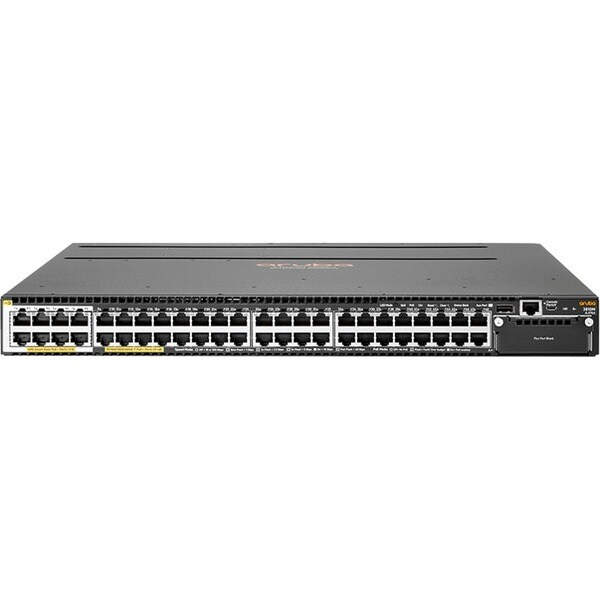
JL428A#AC3
Features
Key Features
- Layer 3 Switch provides reliable, efficient connectivity to ensure maximum feasibility
- Create your own LAN and connect your PC, laptop, printer and other peripherals with the help of 48 ports
- Supports layer 3 switching for enhanced performance and usability
- Rack-mountable form factor for your convenience and simplicity of usage
- Management capability provides control over setup and configuration of your network
- Gigabit Ethernet port for ultra-fast network speeds
- Supports optical fiber cable to span longer distances and provided high data transmission rates between servers and network components
Switch
1x Expansion Slot
1x Stack
Description
The Aruba 3810 Switch Series provides performance and resiliency for enterprises, SMBs, and branch office networks. With HPE Smart Rate multi-gigabit ports for high speed access points and IoT devices, this advanced Layer 3 network switch delivers a better application experience with low latency, virtualization with resilient stacking technology, and line rate 40GbE for plenty of back haul capacity.
A powerful Aruba ProVision ASIC delivers performance, robust feature support, and value with flexible programmability for the latest applications. The 3810 delivers resiliency and scalability via innovative backplane stacking technology and redundant, hot-swappable power supplies all in a convenient 1U form factor. It supports an advanced Layer 2 and 3 feature set with OSPF, IPv6, IPv4 BGP, Dynamic Segmentation, robust QoS, and policy-based routing are included with no software licensing.
Easy to deploy, use and manage using Aruba AirWave or Aruba Central. Aruba ClearPass offers centralized security and external captive portal support. The switches offer a limited lifetime warranty.
ENHANCED CAPABILITIES
Software-defined networks
- Supports multiple programmatic interfaces, including REST APIs and Openflow 1.0 and 1.3, to enable automation of network operations, monitoring, and troubleshooting
Unified wired and wireless support
- Aruba ClearPass Policy Manager provides profiling, authentication, and policy management across multi-vendor wired and wireless networks
- Switch auto-configuration automatically configures switch for different settings such as VLAN, CoS, PoE max power, and PoE priority when an Aruba access point is detected
- User Role defines a set of switch-based policies in areas such as security, authentication, and QoS. A user role can be assigned to a group of users or devices, using switch-based local user role or download from ClearPass
- For improved network simplicity and security, Aruba Dynamic Segmentation automatically enforces user, device and application-aware policies on Aruba wired and wireless networks. Automated device profiling, role-based access control, and Layer 7 firewall features deliver enhanced visibility and performance for a better overall experience for both IT and end-users alike
- Dynamic Segmentation provides a secure tunnel that transports network traffic on a per-port or per-user role basis to an Aruba Controller. In a per-user role Tunnel Node, users are authenticated by the ClearPass Policy Manager which directs traffic to be tunneled to an Aruba controller or switch locally
- Static IP Visibility allows ClearPass to do accounting for clients with static IP addresses
Quality of Service (QoS)
- Advanced classifier-based QoS classifies traffic using multiple match criteria based on Layer 2, 3, and 4 information; applies QoS policies such as setting priority level and rate limit to selected traffic on a per-port or per-VLAN basis
- Layer 4 prioritization based on TCP/UDP port numbers
- Class of Service (CoS) sets the IEEE 802.1p priority tag based on IP address, IP Type of Service (ToS), Layer 3 protocol, TCP/UDP port number, source port, and DiffServ
- Bandwidth shaping
- Port-based rate limiting provides per-port ingress-/egress-enforced increased bandwidth
- Classifier-based rate limiting uses an access control list (ACL) to enforce increased bandwidth for ingress traffic on each port
- Supports per-port, per-queue egress-based reduced bandwidth
How's your experience?
Please don't hesitate to share your thoughts and suggestions with us. Together, we can make your future interactions even more rewarding.Submit Feedback